Wednesday, October 17, 2018
Thursday, October 4, 2018
Compare and Contrast
Choose two of the colonies we have studied. Using your knowledge and the vocabulary below, compare and contrast the two different colonies you chose.
What do they have in common? What are their differences?
Use the handout chart for brainstorming before writing your text.


Wednesday, October 3, 2018
The slaves in the 13 colonies
Slavery was the status of several thousand inhabitants of the Thirteen Colonies. Starting around 1680, more than
100,000 Africans were forcibly transported to these colonies to serve as manual labour. They formed about one-fifth
of the workforce. In South Carolina, nearly half of the population lived in slavery.
Hundreds of slaves had been brought to New York, Boston and Rhode Island, but it was in the southern colonies
where slavery was more deeply rooted. In Virginia and South Carolina, slaves worked on plantations that grew
tobacco, rice and indigo (a plant used to make blue dye). These crops required a lot of labour over very long periods,
and involved backbreaking work in unhygienic conditions. In 1745, cotton was not widely grown in the colonies.
It would only flourish in the 19th century.
where slavery was more deeply rooted. In Virginia and South Carolina, slaves worked on plantations that grew
tobacco, rice and indigo (a plant used to make blue dye). These crops required a lot of labour over very long periods,
and involved backbreaking work in unhygienic conditions. In 1745, cotton was not widely grown in the colonies.
It would only flourish in the 19th century.
Not all slaves worked on plantations. Some cut and sawed wood in North Carolina. On many small farms in the South,
farmers had only one slave who helped him work the land.
In this system, slaves lost their freedom and worked long, hard days. Slaves were considered a commodity, like a tool
that could be bought and sold.
Author: Léon Robichaud

Two types of slavery
Pehr Kalm, Swedish naturalist, during a visit of the 13 Colonies in 1749
“There were two classes of servants in the English colonies, domestics and slaves, and the former class was divided
into two categories:
- Those, of free condition, who rented themselves out for the year at a price ranging from eight to 20 louis (a French coin), not including food.
- Poor immigrants who, not having the means to pay their passage, had agreed with the captain of the ship on which they made the crossing, to let themselves be sold for a few years upon their arrival in America. This category of domestics, who were called indentured servants, included men and women of all ages, and many unfortunates fleeing oppression and religious persecution.”
Monday, October 1, 2018
The Breadbasket Colonies
The Middle Colonies were composed of what is today the states of New York, Pennsylvania, New Jersey and Delaware.
Because the soil was rich in the Middle colonies, farmers were able to grow more grain than they could use. They began selling grain to other colonies and to England, shipping out of the big ports in Philadelphia and New York. Because of this, the middle colonies became known as the Breadbasket colonies.
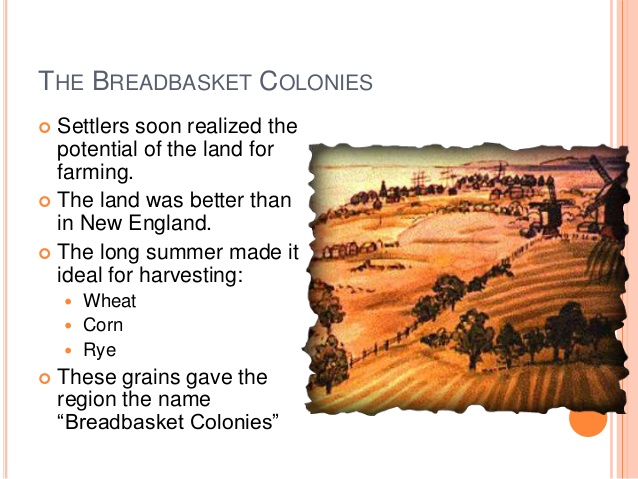
http://www.slideshare.net/ajroets/61-the-middle-colonies-55805719
Source: http://13colonies.mrdonn.org/middlecolonies.html
Sunday, September 30, 2018
Wednesday, September 26, 2018
Jamestown Colony, Virginia Would you have survived?

The Virginia Company was assigned land in the New World by the king of England. They had high hopes of making a lot of money by growing and making things in their colony that they could ship back to England for a profit. To do this, they needed a labor force.
The Virginia Company advertised for colonists. Anyone who agreed to make the journey was promised 50 acres of land and a share in the profits. That was quite an offer. About 1000 people accepted. A ship set sail for the New World.
Jamestown was the name of the area selected by the Virginia Company to be the new home of these colonists. It was a swampy area, nearly an island, connected to the mainland by a sandbar. It was selected because the Virginia Company believed it could be defended. The colonists were not worried about the natives. The Indians in the area seemed friendly. They were worried about Spanish invasion.
The choice of location did not work out well. The colonists soon ran out of game on the "island", and fresh water was in short supply.
They had other problems. The colonists were badly equipped to start a colony. About half of the colonists had been "gentlemen" back in England. They had little or no work experience. They knew nothing about farming or building. They had no intention of doing any of the work. They expected the others to feed and care for them. As you can imagine, this did not go over well with the other colonists.
Hindsight: More colonists might have survived if ...
- Even then, the colonists in Jamestown might have survived if they had had time to plant crops and harvest before winter set in. They did plant. But they were not worried about food. They expected ships to arrive from England. But only a few ships arrived. The ships brought some supplies, but the ships had been sent to take goods back to England, goods that had not yet been created by the colonists.
- If they had abandoned their original settlement and moved inland where food, water, and firewood were in ample supply. Of course, they did not know if the natives would remain friendly if they moved inland. The fort they built on the "island" did offer some protection. So they did not move inland.
As it was, with only two doctors, low supplies of food and fresh water, freezing temperatures, and almost no medicine to combat disease, only about 100 of the original colonists survived Jamestown.

Tuesday, September 25, 2018
Thursday, September 13, 2018
Thursday, September 6, 2018
Tuesday, June 12, 2018
Life on the open seas
rom Visually.
The Age of Exploration: Life on the Open Seas. Find out how sailors were recruited, what was their average diet, and what ailments they had to face while sailing the open seas!
A Hard Day’s Work
Life was pretty difficult for a sailor in the age of exploration. Journeys could take years. Ships only covered about 100 miles a day. The pay was poor. Seamen on Columbus’ journeys made less than $10 a month in today’s money. Crews worked around the clock in shifts minding the ship. Disobedience led to harsh punishments. Beatings and floggings were common, and mutineers were put to death. 16 was the minimum age for sailors, but some boys started working on ships as young as 7 or 8. Some men didn’t join willingly. They were “impressed,” or forced into service.
Life was pretty difficult for a sailor in the age of exploration. Journeys could take years. Ships only covered about 100 miles a day. The pay was poor. Seamen on Columbus’ journeys made less than $10 a month in today’s money. Crews worked around the clock in shifts minding the ship. Disobedience led to harsh punishments. Beatings and floggings were common, and mutineers were put to death. 16 was the minimum age for sailors, but some boys started working on ships as young as 7 or 8. Some men didn’t join willingly. They were “impressed,” or forced into service.
Scurvy, Seasickness and Slime
Sailors consumed about 3,000 calories a day, which they got from: 1 lb. Salted beef or pork; flour mixed with fat was served when meat rations ran low. 1 lb. Biscuit or hardtack; hardtack was infested with weevils and bugs, which sailors ate as additional food. 1 gallon Ale, wine or hard liquor; a salty diet combined with a lack of fresh water led to dehydration. Dried beans, peas or rice. There were no fresh fruits or vegetables. Vitamin deficiencies gave men scurvy—and rotted teeth and gums, open sores and even mental breakdowns. It was common to lose 50 percent of a crew to scurvy, known as the “scourge of the seas.” Explorer James Cook was a pioneer in scurvy prevention. He fed his men sauerkraut and dried vegetable soup. If the diet didn’t kill you, there were plenty of other things that could. Sailors had just one set of clothes that were rarely washed. They thought dirt and grease provided protection from wind and rain. Lice, rodents and foul drinking water spread typhoid fever. Ships could be dangerously cold—fires were only allowed in calmer weather. The lack of fresh air below deck caused carbon monoxide poisoning. Men slept on deck in hammocks—an invention they borrowed from Mesoamerican cultures.
Sailors consumed about 3,000 calories a day, which they got from: 1 lb. Salted beef or pork; flour mixed with fat was served when meat rations ran low. 1 lb. Biscuit or hardtack; hardtack was infested with weevils and bugs, which sailors ate as additional food. 1 gallon Ale, wine or hard liquor; a salty diet combined with a lack of fresh water led to dehydration. Dried beans, peas or rice. There were no fresh fruits or vegetables. Vitamin deficiencies gave men scurvy—and rotted teeth and gums, open sores and even mental breakdowns. It was common to lose 50 percent of a crew to scurvy, known as the “scourge of the seas.” Explorer James Cook was a pioneer in scurvy prevention. He fed his men sauerkraut and dried vegetable soup. If the diet didn’t kill you, there were plenty of other things that could. Sailors had just one set of clothes that were rarely washed. They thought dirt and grease provided protection from wind and rain. Lice, rodents and foul drinking water spread typhoid fever. Ships could be dangerously cold—fires were only allowed in calmer weather. The lack of fresh air below deck caused carbon monoxide poisoning. Men slept on deck in hammocks—an invention they borrowed from Mesoamerican cultures.
Ignominious Ends
Captains didn’t have it much better than their crews. Magellan didn’t make it around the world with his ships. He was killed in the Philippines. Ponce de Leon failed to find the Fountain of Youth, but a poison arrow found him in Florida. Balboa was beheaded after feuding with his bosses. Verrazzano was killed and eaten by cannibals in the Caribbean. A fight over stolen boats ended Cook’s life in Hawaii. Hudson’s crew set him adrift in what is now Hudson’s Bay. He was never heard from again.
Captains didn’t have it much better than their crews. Magellan didn’t make it around the world with his ships. He was killed in the Philippines. Ponce de Leon failed to find the Fountain of Youth, but a poison arrow found him in Florida. Balboa was beheaded after feuding with his bosses. Verrazzano was killed and eaten by cannibals in the Caribbean. A fight over stolen boats ended Cook’s life in Hawaii. Hudson’s crew set him adrift in what is now Hudson’s Bay. He was never heard from again.
Friday, June 8, 2018

Explore the Map
http://www.phschool.com/atschool/ahon/history_interactive/mvl-1021/common_player.html
Wednesday, June 6, 2018
Sunday, June 3, 2018
Wednesday, May 16, 2018
Silk Road- Connecting the ancient world through trade
https://ed.ted.com/lessons/the-silk-road-history-s-first-world-wide-web-shannon-harris-castelo#review
The Silk Road
The Silk Road was a trade route that went from China to Eastern Europe. It went along the northern borders of China, India, and Persia and ended up in Eastern Europe near today's Turkey and the Mediterranean Sea.

Map of the Silk Road - Route in red (later ocean routes in blue)
Why was the Silk Road important?
The Silk Road was important because it helped to generate trade and commerce between a number of different kingdoms and empires. This helped for ideas, culture, inventions, and unique products to spread across much of the settled world.
Why is it called the Silk Road?
It was called the Silk Road because one of the major products traded was silk cloth from China. People throughout Asia and Europe prized Chinese silk for its softness and luxury. The Chinese sold silk for thousands of years and even the Romans called China the "land of silk".
What goods did the Chinese trade?
Besides silk, the Chinese also exported (sold) teas, salt, sugar, porcelain, and spices. Most of what was traded was expensive luxury goods. This was because it was a long trip and merchants didn't have a lot of room for goods. They imported, or bought, goods like cotton, ivory, wool, gold, and silver.
How did they travel?
Merchants and tradesmen traveled in large caravans. They would have many guards with them. Traveling in a big group like a caravan helped in defending from bandits. Camels were popular animals for transport because much of the road was through dry and harsh land.
History
Although there was some trade between China and the rest of the world for some time, the silk trade was significantly expanded and promoted by the Han Dynasty which ruled from 206 BC to 220 AD.
Later, under the rule of the Yuan Dynasty set up by Kublai Khan of the Mongols, trade from China along the Silk Road would reach its peak. During this time the Mongols controlled a significant portion of the trade route, enabling Chinese merchants to travel safely. Also, merchants were granted more social status during the Mongol rule.
Fun facts about the Silk Road
- It was over 4,000 miles long.
- Marco Polo traveled to China along the Silk Road.
- Not all that was traded along the Silk Road was good. It is thought that the bubonic plague, or Black Death, traveled to Europe from the Silk Road.
- Very few merchants traveled along the entire route. Goods were traded at many cities and trade posts along the way.
- There wasn't just one route, but many routes. Some were shorter, but more dangerous. Others took longer, but were safer.
Subscribe to:
Posts (Atom)